What Works

Grade 3 Averages Language and Rank Math % and Rank
India 2017 (Pre-Covid, NAS) 67% 63%
India 2021 (Pandemic, NAS) 62% 57%
India 2024 (Post-Pandemic, PRS) 64% 60%
UP 2017 (Pre-Covid, NAS) 58% 32nd 59% 27th
UP 2021 (Pandemic, NAS) 58% 25th 54% 22nd
UP 2024 (Post-Pandemic, PRS) 68% 7th 64% 7th

CAN WE LEARN FROM UTTAR PRADESH’S FLN TURNAROUND?

Uttar Pradesh (UP), once seen as an educational underperformer, is now emerging as a strong performer in foundational learning. Between 2021 and 2024, while India’s Grade 3 scores rose only 2–3 percentage points, UP improved by 10 points in both language and mathematics— moving from below the national average to above it. The state also climbed sharply in rankings, from 25th to 7th in Language and from 22nd to 7th in Mathematics.

This turnaround was driven by focused reforms and leadership. In 2019, Chief Minister Yogi Adityanath launched Mission Prerna to ensure all primary students achieve foundational literacy and numeracy. The state publicly set quantifiable Prerna Lakshya (learning goals). “For example, in Grade 3, a child is expected to read at a fluency of 30 words per minute and solve 75% of single-digit addition and subtraction problems,” explained Vijay Kiran Anand, the state’s first Director General of School Education.

These targets were widely shared with teachers and communities, ensuring alignment and accountability across the system. This was followed up by good efforts of subsequent DGSEs under direction of Principal Secretaries and the Chief Minister himself. Such great, nononsense leadership from the top has been one of the major factors in UP’s turnaround. PARAKH reports provide an insight into what’s happening within the FLN space.

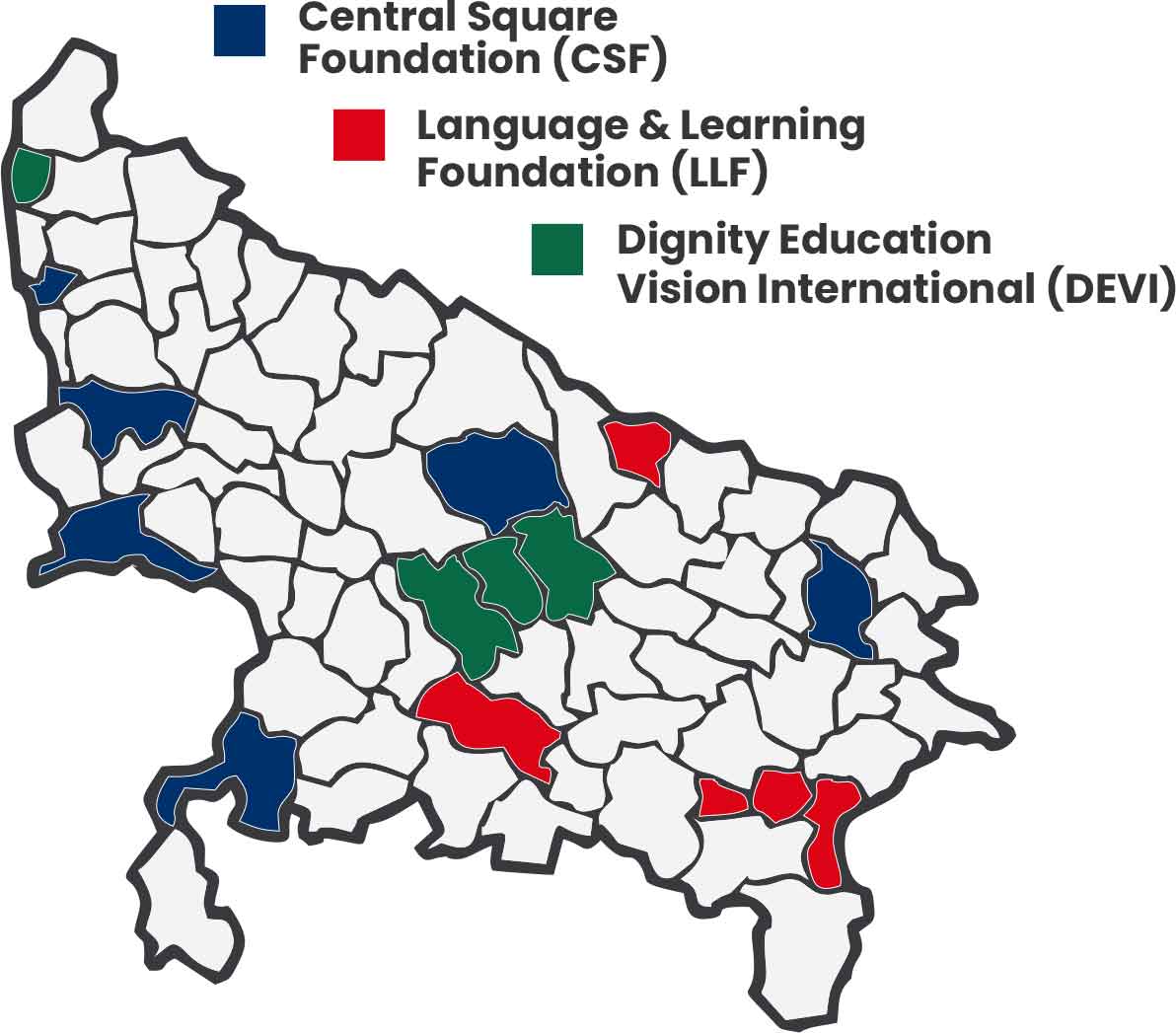
Three NGOs (CSF, LLF< DEVI) were given a total of 15 districts to try out their FLN interventions. This report discusses how they added value. An overview of the three approaches is given overleaf. Each approach has its strengths, but one NGO which used a pedagogical approach and focused on classroom transaction of learning produced above average outcomes. At the more granular level of competencies, too, it produced the largest gains in each category. This does not necessarily imply a causal relationship, but DEVI’s ALfA pedagogy may have been a contributing factor, which ensures that all classroom time is used fully, with children learning joyfully in pairs.

FLN INTERVENTIONS BY DIFFERENT NGOS IN UP

CENTRAL SQUARE FOUNDATION (CSF)

6 Districts: Agra, Aligarh, Ghaziabad, Jhansi, Gorakhpur and Sitapur.

Approach:
  • District PMU model governance capability building data-driven execution
  • Supports NIPUN BHARAT Mission at the state level through holistic system approach.
  • Support Early Childhood Education (ECE) at the SPO.
  • Provide technical support in regular monitoring of the implementation of the NIPUN Bharat program.
LANGUAGE AND LEARNING FOUNDATION (LLF)

5 Districts: Varansi, Fatehpur, Shravasti, Chanduali and Bhadohi.

Approach:
  • Structured pedagogy Teacher Professional Development, mentoring & academic support cocreated TLMs
  • Creation of high-quality materials for English and Mathematics, including workbooks, teacher guides, storybooks, and training manuals for Balvatika (Grade 3).
  • Designing remedial teaching materials and techniques for Classes 4 and 5.
  • To provide supportive supervision material for ARP, SRG and Master trainers.
DIGNITY EDUCATION VISION INTERNATIONAL

Districts: Lucknow, Unnao, Shamli, and Barabanki.

  • ALfA pedagogy paired-learning routines Professional Development
  • The initiative uses the ALFA FLN Booster Program, gives hands-on materials for children to work in pairs.
  • Children take turns to read, do activities and ask each other questions.
  • DEVI conducts teacher training & empowers goverenment mid-level leaders to ensure effective implementation.
  • The program includes the ALfAWay app, offering free online content accessible via mobile devices.
Joyful Learning leads to greater attendance

NAS 2021 TO PARAKH 2024

Uttar Pradesh’s impressive improvement in foundational literacy and numeracy between NAS 2021 and Parakh 2024 offer encouragement that India’s FLN crisis is not inevitable; solutions are at hand.

Digging into the inter-district variations shows that policy focus alone is not sufficient; what ultimately drives learning gains is what happens inside classrooms. When policy and pedagogy work together, they multiply impact and lead to higher learning gains. Pedagogy, which has been ignored as a major factor, needs to become a central focus in light of these results.

Districts implementing the ALfA (Accelerating Learning for All) model through DEVI achieved learning gains (+13 to +14 pp) that were significantly higher than both the state average (+10pp) and districts supported by other major NGOs (+6 to +9 pp).

Despite operating as a short, low-cost, 45-day supplement, ALfA delivered larger improvements in both literacy and numeracy by shifting classrooms from teacher-led coverage to processled learning, with children actively decoding, explaining, and working in pairs.

The UP experience makes a clear case that effective pedagogy is as critical as governance, monitoring, and materials. Sustainable FLN reform requires not only the right policy priorities, but teaching–learning processes that reliably translate those priorities into accelerated learning in every classroom, for every child.
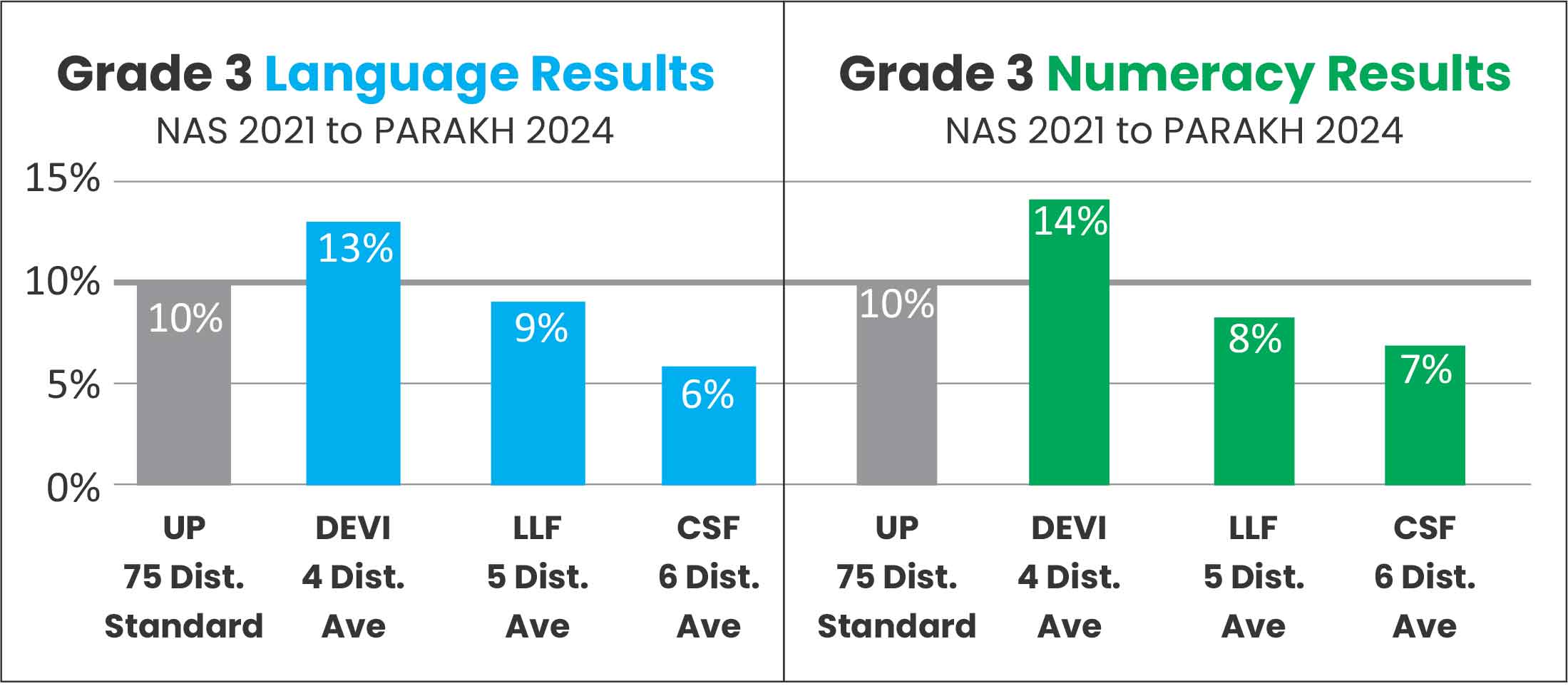
  • Literacy Gain
  • Numeracy Gain

FLN IN UTTAR PRADESH NGO PARTNERS

Three NGOs have been working on FLN in a combined total of 15 of the 75 districts of UP:

CSF Cluster 6 districts
LLF Cluster 5 districts
DEVI Cluster 4 districts

This report compares outcomes for Grade 3 from NAS 2021 to PRS 2024. UP overall made impressive gains (+10pp in both language and mathematics) as a result of its policies and macro-level measures. However, there is significant district-level variation, which reveals interesting patterns.

  • CSF: Central Square Foundation
  • LLF: Language & Learning Foundation
  • DEVI: DEVI Sansthan (Dignity Education Vision International)
  • NAS: National Achievement Survey
  • PRS: PARAKH Rashtriya Sarvekshan
NGO Students(approx.) Teachers*(approx.) Schools(approx.) Grade span(FLN focus) Districts(UP)
CSF 350,000 25,000 8,400 1 - 3 Agra, Aligarh, Ghaziabad, Jhansi, Gorakhpur, Sitapur
LLF 450,000 15,000 6,300 1 - 3 Bhadohi, Chandauli, Fatehpur, Shravasti, Varanasi
DEVI 510,000 30,000 7,500 1 - 5 Shamli, Lucknow, Barabanki, Unnao
Data Sources & Assumptions:
  • The data above is based on what is available publically.
  • Number of schools are based on the latest available UDISE+/NAS/PRS data.
  • FLN-focussed Grades 1–3 are a subset of these totals. Grades 1–3 usually account for around 60% of total enrollment in Grades 1–5.
  • Teachers are not strictly grade-specific, but around 60% may be considered actively engaged in FLN (Grades 1–3).

NAS 2021 TO PRS 2024

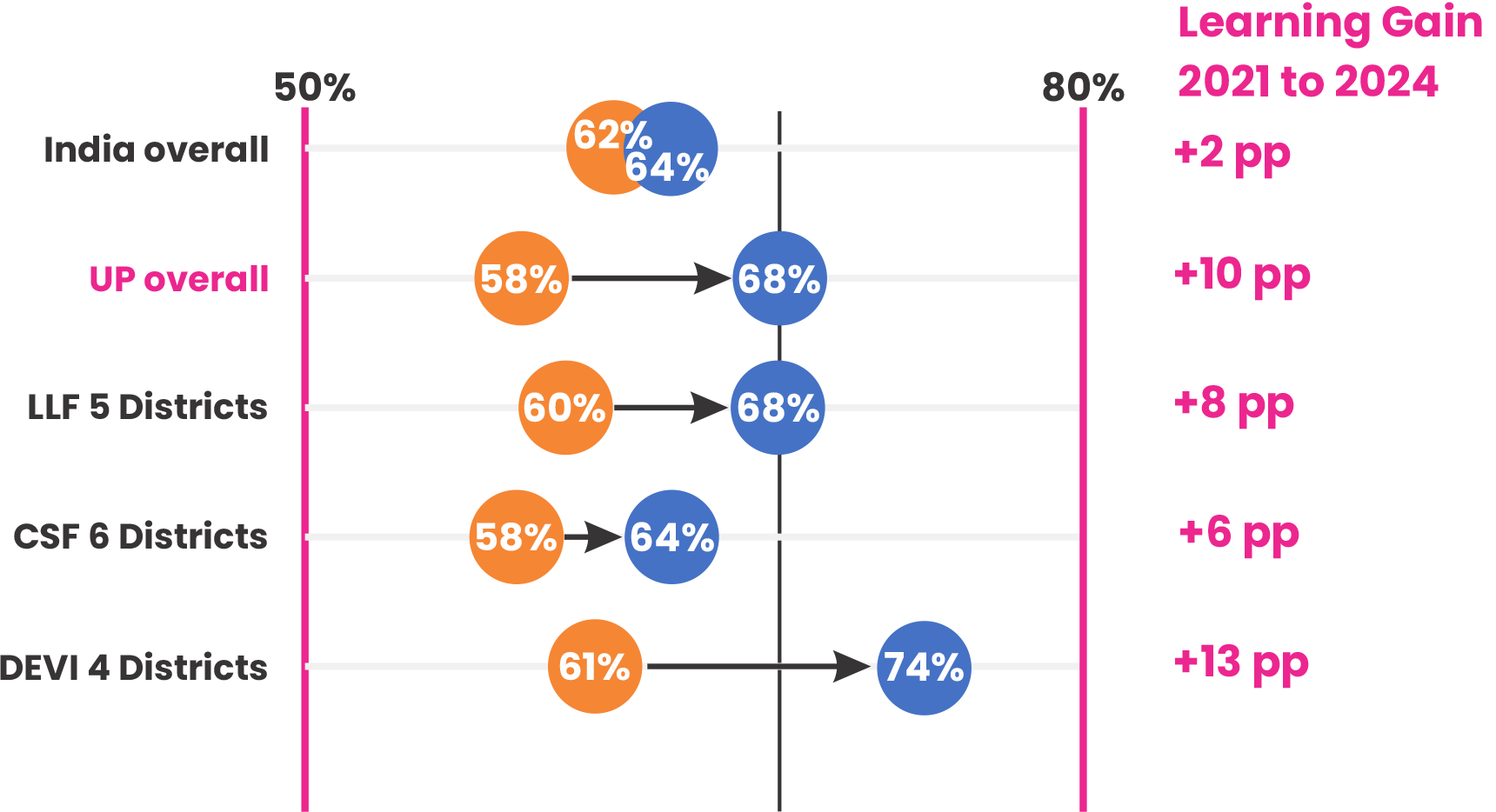
The districts the different NGOs are working in had similar performance in Grade 3 language in the 2021 NAS, but by 2024 a significant gap existed, with DEVI’s district having gained a bigger ground as per table below, organized from highest to lowest gains both in terms of percentage points (pp) and relative gain % (PRS-NAS)/NAS x 100.

Group NAS 2021 (%) PRS 2024 (%) Gain (pp) Relative Gain (%)
India Overall 62 64 +2 +3.2%
UP Overall 58 68 +10 +17.2%
LLF (5 districts) 60 68 +8 +13.3%
CSF (6 districts) 58 64 +6 +10.3%
DEVI (4 districts) 61 74 +13 +21.3%

Language GAIN by NGO for Grade 3

NAS 2021 to PARAKH 2024

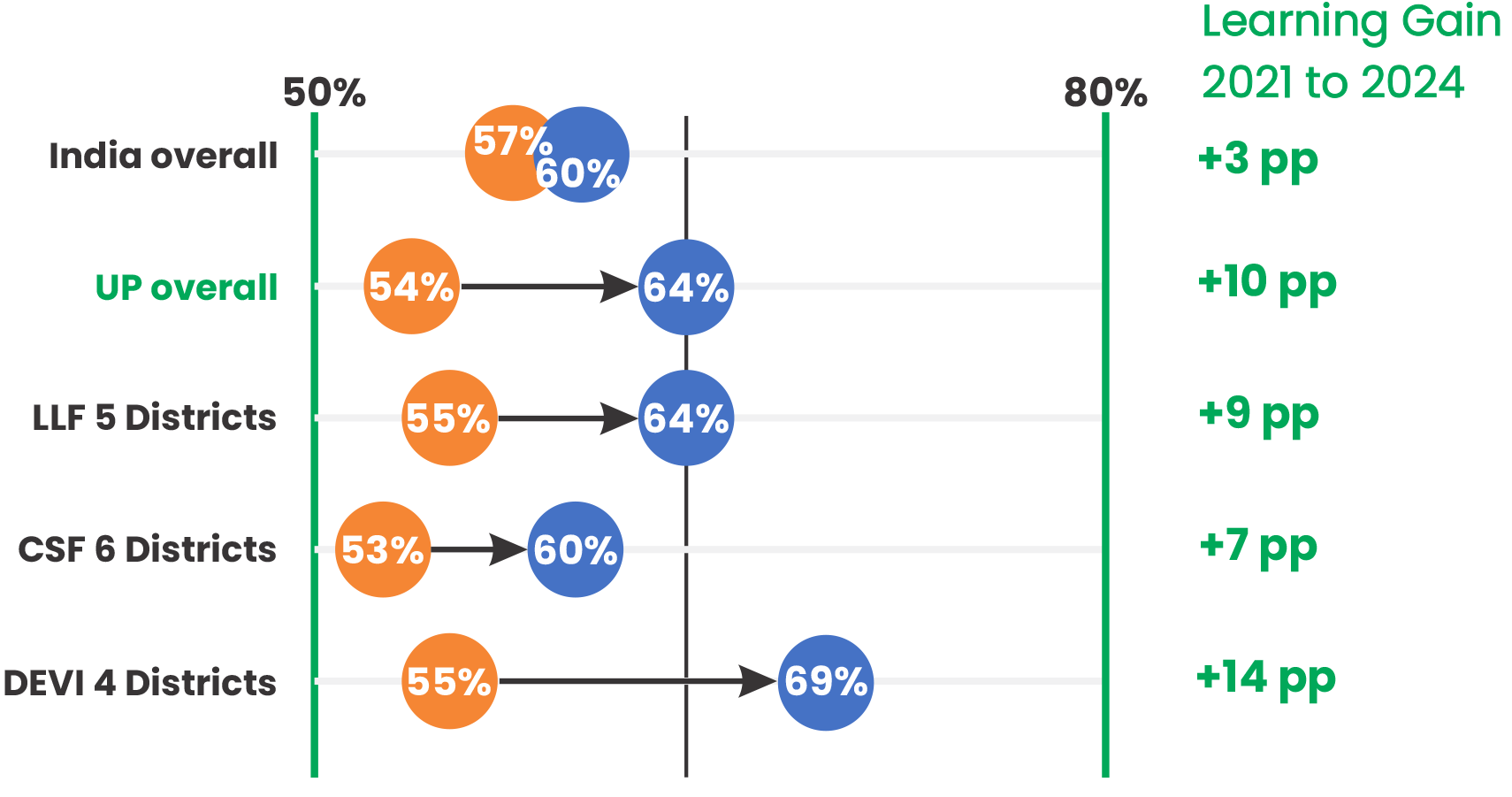
The districts the different NGOs are working in had similar performance in Grade 3 Mathematics in the 2021 NAS, but by 2024 a significant gap existed, with DEVI’s district having gained a bigger ground as per table below, organized from highest to lowest gains both in terms of percentage points (pp) and relative gain % (PRS-NAS)/NAS x 100.

Group NAS 2021 (%) PRS 2024 (%) Gain (pp) Relative Gain (%)
India Overall 57 60 +3 +5.3%
UP Overall 54 64 +10 +18.5%
LLF (5 districts) 55 64 +9 +16.4%
CSF (6 districts) 53 60 +7 +13.2%
DEVI (4 districts) 55 69 +14 +25.5%

Numeracy GAIN by NGO for Grade 3

NAS 2021 to PARAKH 2024